The right sealing system depends on the pipe or cable, the wall or floor, the opening and the required fire and smoke resistance. For plastic pipes, for example, collars, wrap strips and certain graphite sealants are available. For cables and mixed penetrations, mortar, board material, blocks or special penetration foam may also be suitable.
The product name alone is not conclusive. What matters is the complete installation: from pipe insulation and seal depth to fixing and spacing.
Can fire-resistant PU foam be used in a penetration?
Yes, if the specific foam system is demonstrably suitable for that penetration and is applied in accordance with the associated instructions.
Special foam systems for cable and pipe penetrations do exist. Promat, for example, describes PROMAFOAM-2C as a two-component polyurethane-based foam for certain penetration applications. Hilti also offers a foam system for cables and mixed penetrations: CFS-F FX.
That does not mean every can labelled ‘fire-resistant’ is suitable. If a product's documentation only covers applications in joints, you cannot use it around pipes on that basis.
So check what the documentation applies to:
- Penetration seals: NEN-EN 1366-3 is a relevant test standard for these.
- Linear joint seals: NEN-EN 1366-4 applies to these.
A result for a joint between building elements does not prove the performance of a cable or pipe penetration.
With an existing foam seal, it must therefore first be established which product was used and whether the application is substantiated. The colour or appearance of the foam alone is not enough to tell.
The main sealing systems compared
This table helps with an initial selection. Always check the documentation of the specific system before making the final choice.
| System | Possible applications | How it works or is built up | Key points to check |
|---|---|---|---|
| Fire collar | Certain plastic and composite pipes | A housing containing material that expands when heated and closes the opening | Pipe type, diameter, wall thickness, fixing and installation side |
| Wrap strip | Certain plastic pipes and insulated pipes | Intumescent material around the pipe, in the prescribed position | Number of layers, width, position and combination with the rest of the seal |
| Fire-resistant sealant or paste | Depending on the product: cables, pipes, small openings and joints | Fills and closes the opening; some products are strongly intumescent | Product type, seal depth, backing material and permitted penetrations |
| Stone wool boards with coating or sealant | Cables, cable trays and mixed penetrations | A prescribed combination of boards, sealants and any additional provisions | Board type, thickness, number of layers, connections and treatment of penetrations |
| Fire-resistant mortar | Certain larger openings and cable or pipe penetrations in solid walls and floors | A mineral filling, possibly combined with collars, wraps or other components | Filling thickness, substrate, support and additional provisions |
| Fire-resistant blocks, plugs or cushions | Certain cable and mixed penetrations, including where later changes are expected | Preformed elements placed according to a defined build-up | Opening size, permitted penetrations, fit and rules for changes |
| Special fire-resistant penetration foam | Certain cables, cable bundles and mixed penetrations | A product-specific foam system with prescribed dimensions and installation | Suitability for penetrations, minimum depth, spacing and any extra components |
Manufacturers offer different system build-ups for this. Nullifire, for example, describes separate solutions with graphite sealant, coated stone wool boards and fire-resistant mortar; Hilti offers blocks, plugs and cushions, among others. These product groups are not interchangeable without checking the application.
Plastic pipes: a collar is not the only option
In a fire, a plastic pipe can soften, deform or melt away. The seal must account for the opening that this can create.
A fire collar or wrap strip is a common solution for this. But other substantiated systems also exist. Nullifire FS709, for example, is an intumescent graphite sealant with applications around certain plastic pipes. The claim that sealant is never suitable for plastic pipes is therefore too general.
When selecting, look beyond the outside diameter. The pipe material, wall thickness, any insulation and the use of the pipe can also be decisive.
An application for a certain type of PVC pipe does not automatically apply to a multilayer pipe of the same size. Check the relevant configuration in the system documentation.
Metal pipes: assess the insulation too
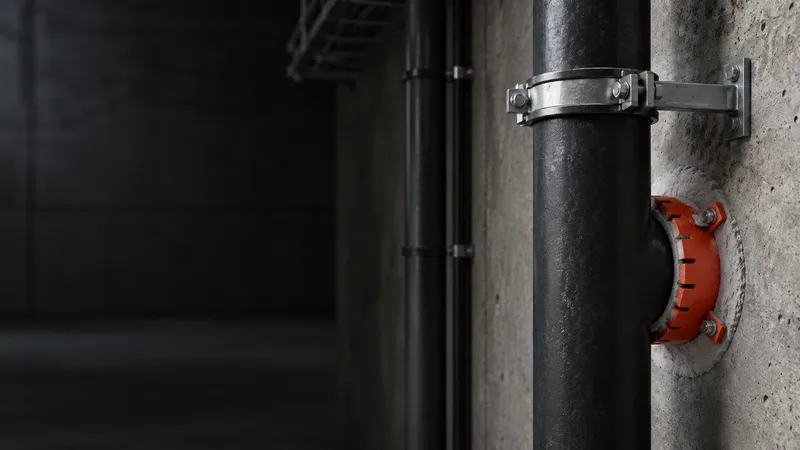
Metal pipes can conduct heat through a separating construction. In addition to sealing the opening, pipe insulation may therefore be needed to achieve the required performance.
Which insulation is needed differs per system and application. Check:
- the pipe material, diameter and wall thickness;
- the type and thickness of the insulation;
- the prescribed insulation length;
- whether the insulation must run through the seal or is interrupted.
There are also substantiated applications without additional insulation. A fixed rule such as ‘all metal pipes must be insulated on both sides’ is therefore not correct either. The system documentation distinguishes between different configurations and performances.
Mixed penetrations: assess the whole opening
In a mixed penetration, cables, a metal pipe and plastic pipes, for example, run through the same opening. In that case, check not only whether each component appears in the documentation separately, but also whether the combined installation falls within the scope of application.
Think of the spacing between services, the distance to the edge, the permitted fill and any extra collars or wraps.
Does the existing situation not fit any available solution? Then have it assessed whether the layout needs to be changed or whether additional technical substantiation is possible. Dividing an opening also has to be worked out structurally and in terms of fire safety.
The wall or floor helps determine which solution is suitable
A seal is part of a separating construction. The system must therefore suit the wall or floor in which it is installed.
Before the work, check at least:
- Type of construction: for example a solid wall, lightweight partition or floor.
- Thickness and build-up: including any requirements for boards, studs and opening edges.
- Opening: dimensions, shape and available seal depth.
- Penetrations: materials, dimensions, insulation and spacing.
- Installation: fixings, support of pipes and treatment on one or both sides.
An application in concrete does not automatically apply to a plasterboard wall. A system that can be installed from one side must also be explicitly suitable for that method of installation.
Testing of penetration seals takes into account the interaction between the seal and the surrounding separating construction.
Which documents show that the application is correct?
Ask for documentation that allows the proposed installation to be checked recognisably. Depending on the system, this means:
- A classification report or relevant European Technical Assessment (ETA): for performance and conditions of application.
- The declaration of performance (DoP), where applicable: for the declared product performance.
- The installation instructions and the chosen construction detail: for the actual build-up.
- A recorded additional assessment: if a deviating application is based on it.
Not every permitted variant has to have been tested exactly as such. Standards contain rules for the direct field of application and for substantiated extension of test results. NEN-EN 15882-3, for example, describes how extended applications of results for penetration seals can be substantiated.
The installation must fall within that substantiated field of application. A similar product, an extra layer of sealant or a different fixing must not be treated as equivalent without assessment.
IPLO stresses that a product certificate does not in itself prove that the complete construction complies. The application and combination of products must also be right.
Assess fire resistance and smoke resistance separately
A designation such as EI 60 describes a fire resistance performance: integrity and thermal insulation for 60 minutes under the relevant test conditions.
It does not automatically follow how much smoke can leak through the seal at lower temperatures. The fire test under NEN-EN 1366-3 is not intended to quantify that leakage rate.
For smoke resistance, the distinction between two levels is important:
- Ra and R200 are used for requirements on the resistance to smoke passage between spaces, determined in accordance with NEN 6075.
- Sa and S200 describe the smoke leakage performance of construction components.
Which requirement applies depends, among other things, on the situation: existing building, new build or renovation.
So ask for substantiation of the penetration's contribution to the required smoke resistance. A separate smoke test is not always needed: depending on the component, NEN 6075 offers different assessment options.
During installation, follow the prescribed finishing. The general statement that ‘a small gap may remain’ in a fire-resistant seal is not a usable installation rule.
What should you check on an existing seal?
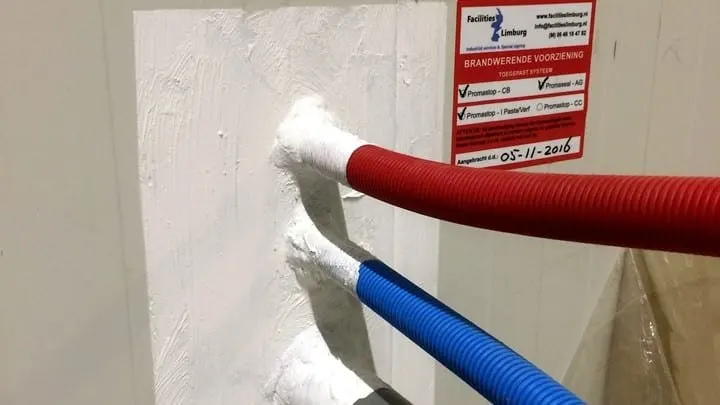
A neat finish or registration label is a good starting point for an investigation, but does not tell you everything about what is behind the visible surface.
If in doubt, ask for the system used, the construction detail and the available handover photos. Have it established whether the seal depth, the build-up behind it and any additional provisions are sufficiently known.
Was a cable added or a pipe replaced later? Then check again whether the changed situation falls within the field of application and whether repair is needed. Some systems are designed for changes, but the installation conditions still apply.
How Grazy helps with choosing the system
During a survey, Grazy Brandwering maps the cables and pipes passing through, the separating construction and the available space. That information forms the basis for selecting a suitable solution.
For a verifiable handover file, the chosen system, the relevant technical substantiation, the location and the work carried out then matter.
Would you like to have it assessed whether the seals in your building suit the penetrations present? See our service for fire-resistant sealing of cable and pipe penetrations. When you get in touch, share any available drawings, product data and photos. That makes it clearer which additional investigation is needed.
Want to know more about fire-resistant seals?
Sealing penetrations against fire with collars, wrap strips, sealant, mortar or other systems with a substantiated application, so that the WBDBO of your fire separation stays intact.
More about fire-resistant seals