
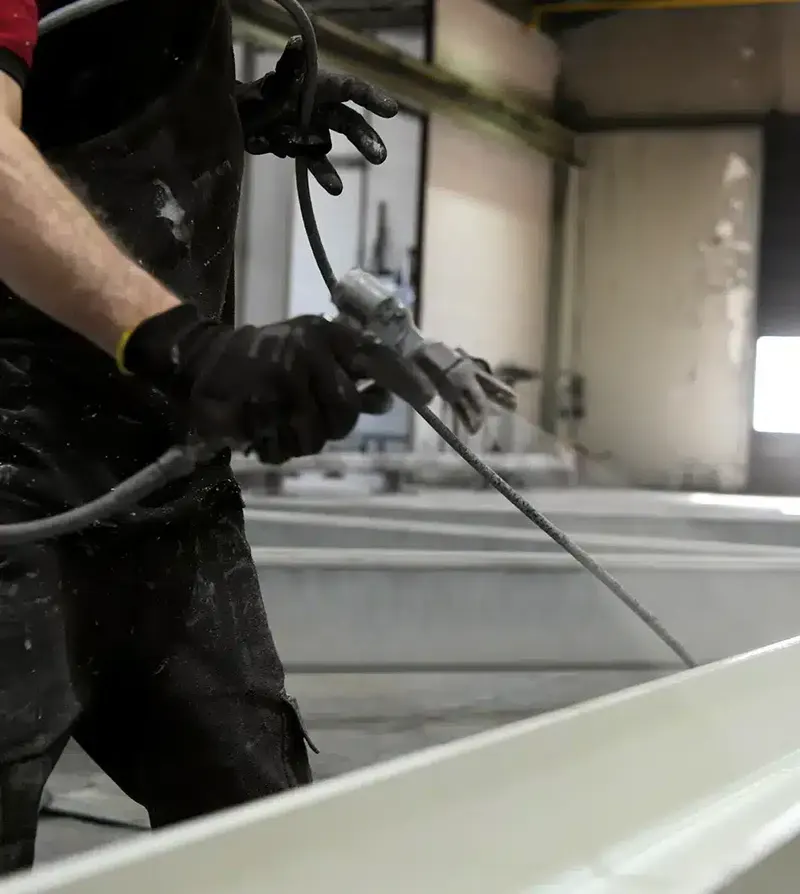
Fire-resistant coating, cladding and spray protection for steel structures
Fire-resistant cladding or coating for steel beams and columns, so load-bearing capacity is retained for up to 120 minutes in a fire.
At high temperatures, unprotected steel loses a large part of its strength within minutes. For steel columns, beams and truss structures that carry the stability of a building, that is a real risk during a fire.
We make steel fire-resistant in the way that suits your structure: intumescent coating that foams up in a fire, spray-applied protection with sprayed plaster, or cladding and boxing-in with boards such as Promatect. All three keep the steel temperature below the critical limit for longer, so the load-bearing capacity is retained for the required fire resistance duration.
Which technique it becomes depends on the section factor, the required fire resistance and whether the steel remains visible. Cladding a steel beam in a plant room calls for something different than coating a steel structure in an entrance hall where the profile must stay visible. For closed ceilings and shafts, boxing-in with board material is often the quickest route. We determine that during the survey, not afterwards.
What you can expect
- Coating, spray protection or cladding - matched to the section factor and structural requirements
- Fire resistance of 30, 60, 90 or 120 minutes in accordance with NEN-EN 13381
- For steel beams, columns, girders, trusses and roof structures
- Clean finish for exposed work - visible steel stays visible
- Making steel fire-resistant in new build and in existing buildings that remain in use
Applications
Standards & certification
- NEN-EN 13381 - determination of fire resistance of structural components
- Besluit bouwwerken leefomgeving - fire resistance with regard to collapse
Our team works VCA-certified and our organization is ISO 9001 and Kiwa (K21050) certified.
More about our certificationsWhat does fire-resistant steel cladding cost?
What it costs to coat or clad a steel structure depends mainly on the required fire resistance duration (30, 60, 90 or 120 minutes), the profile type and section factor of the steel, the total surface area, accessibility (scaffolding or aerial platform) and the chosen technique. At 30 or 60 minutes, intumescent coating is often the most economical route, and the profile stays visible. At 90 or 120 minutes, the required coating thickness can become so great that cladding with boards works out cheaper; board installation is also quicker, because there are no drying times. Spray-applied protection is usually the cheapest option where the finish is not exposed. Exposed work with a clean finish costs more than cladding in a plant room. After a survey you receive a quotation per metre or per element, with no surprises afterwards.
Common mistakes
- Applying an intumescent coating without determining the section factor, so the coating thickness does not match the required fire resistance duration.
- Cladding a steel beam but leaving out the connections to walls and floors, so heat still reaches the steel via the flanks.
- Spraying or coating onto a substrate with rust or dirt, so the layer does not adhere and comes loose.
- Not repairing damage caused by other construction activity, leaving the protection locally absent.
Where we have done this
Including at De Nederlandsche Bank, WTC Amsterdam, Cooltower Rotterdam and ASML Veldhoven - buildings where a rejected fire separation is not an option.
De Nederlandsche Bank
Amsterdam, Utrecht and Amersfoort · 2024
Complete upgrade of the fire compartmentalization during a large-scale office renovation.
View case studyASML Veldhoven
Veldhoven · 2024
Fire-resistant protection of steel structures and technical penetrations in a high-tech production environment.
View case studySpuistraat Den Haag
Den Haag (city centre) · 2026
An old building converted into three apartments with a shop: steel structure clad for fire resistance, ventilation and penetrations made fire-resistant.
View case studyCommercial unit Emmeloord
Emmeloord · 2026
Steel columns and edge beams boxed in with fire-resistant board cladding, running continuously from floor to ceiling.
View case studyThis is how we approach it
Survey & quote
We map out the situation and provide a detailed quote with scope and schedule.
Certified execution
Our VCA team carries out the work in accordance with applicable NEN standards, with minimal disruption.
Delivery & logbook
You receive a delivery file and digital logbook, and a maintenance contract if desired.
Questions about fire-resistant steel cladding
An intumescent coating applies a thin foaming layer to the steel that expands into an insulating foam in a fire; the profile stays visible. Cladding or boxing-in places boards around the profile. That is more robust, quicker to install and often cheaper at 90 or 120 minutes, but the steel is hidden from view. Spray-applied protection sits in between: a sprayed plaster that is quick to apply, suitable where the finish is not exposed.
That depends on the structural function and the requirements of the Besluit bouwwerken leefomgeving. If the beam or column contributes to the main load-bearing structure or to a fire separation, a requirement of 30, 60, 90 or 120 minutes generally applies. A non-load-bearing beam in a low-rise building often does not need to be protected. We assess this during the survey on the basis of the structural calculation.
Via the section factor (A/V) of each profile, combined with the required fire resistance duration and the critical steel temperature. For each profile that yields a prescribed dry film thickness from the system's test report. Without that calculation the coating thickness is wrong and the classification cannot be demonstrated.
With an intumescent coating, visible steel largely stays visible; the architectural appearance hardly changes. If you opt for cladding with boards, the profile is boxed in.
Yes. The work is planned in phases and coordinated with the use of the building to limit disruption, outside office hours or around the production schedule if necessary.
From the knowledge base
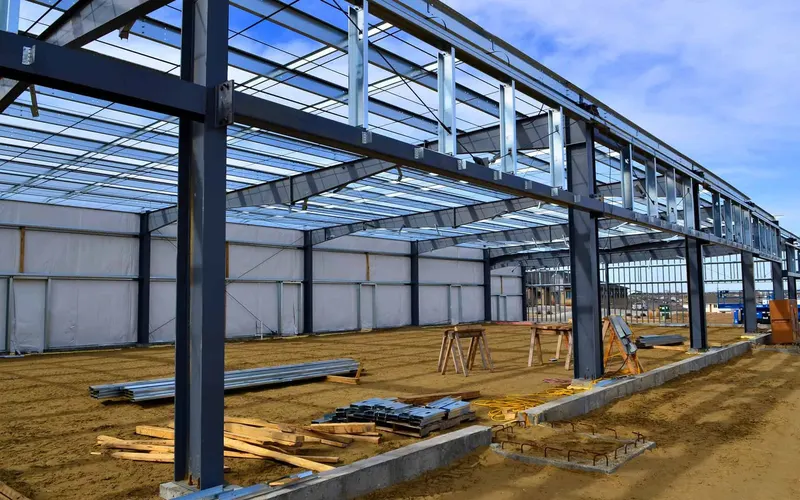
Fire-resistant coating or cladding: which suits your steel structure?
Two ways to protect steel, with different costs and consequences. When do you choose coating, and when board cladding?
Read moreMaintenance and durability of fire-resistant coatings: the complete guide
Fire-resistant coatings on steel can last a long time, but not on their own. How to keep them in good condition.
Read more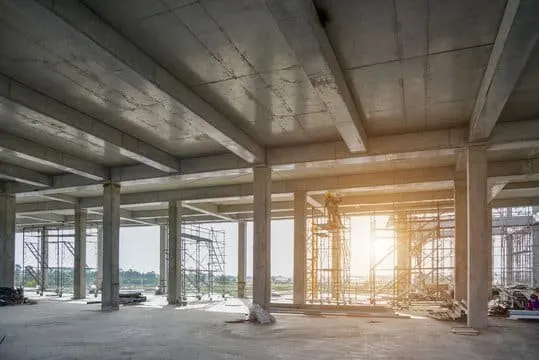
Fire safety and EV charging infrastructure in parking garages: what changes?
Which Bbl rules apply to charging points in car parks, and where charging projects affect fire separations. What the growth of EV charging means for fire safety.
Read moreWhere fire-resistant steel cladding often comes into play
Data centers
Fire separations and penetrations around critical IT infrastructure, executed without downtime.
View sectorParking garages
Structural protection and compartmentalization in parking garages, including the risks of EV charging.
View sectorLogistics & industry
Compartmentalization and structural protection in distribution centers and production halls.
View sectorRelated services
Fire-Resistant Glass
Fire-resistant glass made to measure: glazed partitions, screens and glazing with EI 30 or EI 60 classification, supplied and installed.
More about fire-resistant glassFire-Resistant Doors
Fire doors made to measure, adjusted or refurbished: up to 60 minutes fire resistance, smoke-resistant where required, self-closing and certified.
More about fire-resistant doorsFire dampers
Installing, testing and maintaining fire dampers: automatic shut-off of ventilation ducts at every compartment boundary.
More about fire dampersActive in: Eindhoven · Noord-Brabant · Rotterdam and more