
Fire dampers: installation, inspection, and maintenance
Installing, testing and maintaining fire dampers: automatic shut-off of ventilation ducts at every compartment boundary.
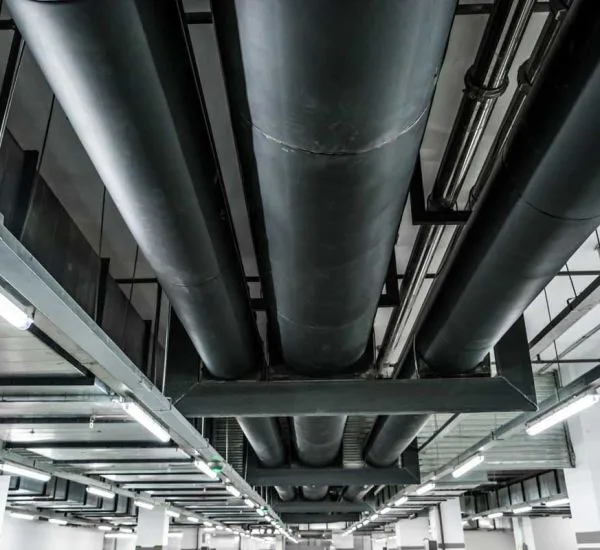
Ventilation ducts run straight through fire compartments and, without measures, form a direct route for fire and smoke. Fire dampers automatically close off this route as soon as needed.
We handle the entire process: installing fire dampers in new and existing ventilation ducts, in accordance with the installation instructions and within the damper's field of application, with the prescribed installation all round, and then periodically testing and maintaining them according to the manufacturer's instructions. A damper closes automatically when the temperature in the duct rises, via a fusible link or thermal mechanism, or via control from the fire alarm system.
Maintenance is where it goes wrong in practice. A fire damper that has not moved for years often no longer closes fully during a function test. That is why we test every damper, record the outcome per damper and repair or replace whatever does not work - recorded in your logbook, so the inspection is demonstrable.
What you can expect
- Installing fire dampers in existing and new ventilation ducts
- Automatic closure when temperature rises in the duct
- Installation according to the instructions: mortar, mineral wool or an approved dry installation kit
- Periodic inspection and function tests, with the outcome recorded per damper
- Repair or replacement of dampers that fail the function test
Applications
Standards & certification
- NEN-EN 1366-2 - testing of fire dampers
- NEN-EN 13501-3 - classification of fire dampers
- NEN-EN 15650 - product standard for fire dampers
- Test frequency according to the manufacturer's instructions
Our team works VCA-certified and our organization is ISO 9001 and Kiwa (K21050) certified.
More about our certificationsWhat do fire dampers cost?
For fire dampers, the price is determined by the quantity, duct dimensions, installation situation (new duct or retrofit), accessibility above ceilings, and the required perimeter sealing. We offer periodic testing and maintenance as a standalone visit or within a maintenance contract, with the price per damper decreasing as the number increases.
Common mistakes
- Installing the damper without the prescribed installation according to the instructions, so that the fire separation still leaks.
- Skipping periodic function tests, allowing a jammed mechanism to go unnoticed.
- Boarding up dampers after a renovation or making them inaccessible for inspection.
Where we have done this
Including at De Nederlandsche Bank, WTC Amsterdam, Cooltower Rotterdam and ASML Veldhoven - buildings where a rejected fire separation is not an option.
Cooltower Rotterdam
Rotterdam · 2023
Fire-safe compartmentation in a new residential tower of more than 150 metres in the centre of Rotterdam.
View case studyMaanplein Den Haag
Den Haag · 2023
Shafts, toilet waste pipes, heat recovery ducts, water pipes and meter cupboards fire-stopped in a new apartment complex.
View case studyMiddin Kijkduin
Den Haag (Kijkduin) · 2025
Fire-resistant floors and walls, penetrations, air ducts, fire dampers and cable trays during the renovation of a building more than a hundred years old.
View case studyFor contractors and installers: Fire-resistant penetrations in non-residential buildings. Or submit a project request directly.
This is how we approach it
Survey & quote
We map out the situation and provide a detailed quote with scope and schedule.
Certified execution
Our VCA team carries out the work in accordance with applicable NEN standards, with minimal disruption.
Delivery & logbook
You receive a delivery file and digital logbook, and a maintenance contract if desired.
Questions about fire dampers
According to the manufacturer's instructions, which differ per type. For the FK2-EU, for example, TROX specifies a function test at least every six months; after two consecutive successful tests the interval may be extended to a year. In some situations, such as with dirty or greasy air, more frequent testing may be needed. If you cannot show during an inspection that the dampers work, the compartmentation at that point has not been demonstrated.
Then we repair the damper where possible - cleaning, freeing the mechanism, replacing the fusible link - and replace it if that is not enough. The outcome per damper goes into the logbook, including what was done.
Yes. The damper is installed in accordance with the installation instructions, with the prescribed installation all round; that installation is part of the damper's field of application and is often forgotten in installations put in by third parties.
Yes - inspection, function testing and, where necessary, repair or replacement of existing fire dampers, including those originally installed by another party.
From the knowledge base
Fire dampers: how they work, inspection frequency, and common mistakes
A fire damper can be the weakest link in compartmentation if it is not installed correctly or not tested periodically. How it works, and how to check that it still does what it should.
Read more
Fire compartmentalization in utility buildings: the complete guide
Why compartmentalization forms the backbone of fire safety in offices, shops, and industrial buildings.
Read more
Fire safety duty of care under the Bbl: what does it mean for owners and users?
The Bbl contains several duties of care, each with its own subject. What Articles 3.5, 6.4 and 2.6 mean for owners, users and managers.
Read moreWhere fire dampers often come into play
Related services
Fire-Resistant Separating Structures
Fire-resistant walls, partition systems and ceilings that divide your building into manageable fire compartments.
More about fire-resistant separating structuresConsultancy & Assessment
From a quick fire safety scan to a full survey: we map out the fire safety of your building clearly.
More about consultancy & assessmentMaintenance & Inspection
Periodic maintenance and inspection of your fire protection, with everything verifiably recorded in a digital logbook.
More about maintenance & inspection