
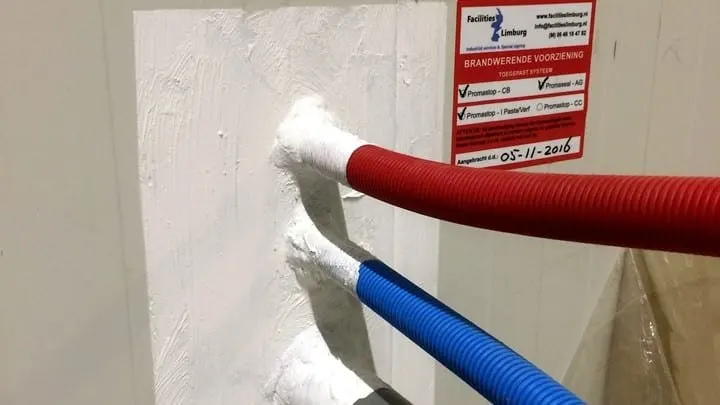
Fire-stopping cable and pipe penetrations
Sealing penetrations against fire with collars, wrap strips, sealant, mortar or other systems with a substantiated application, so that the WBDBO of your fire separation stays intact.
Every cable, pipe or duct that passes through a fire-resistant wall or floor is a potential weak point. Unsealed penetrations are one of the most common causes of compartmentation failing during a fire: fire, and smoke above all, find their way through the opening nobody closed.
We handle fire-resistant sealing of penetrations across the board: single cables and cable bundles, metal and plastic pipes, air ducts, and the combinations of these that are the hardest in practice. Depending on the opening, we use fire collars, wrap strips, fire-resistant sealant or paste, mortar or other systems - always a system whose application for that specific combination is substantiated.
Fire-stopping the filling of service shafts and sealing joints and seams also belong here. A shaft running across several storeys would otherwise connect all the compartments it passes through. After the work we mark every penetration and record what has been applied where, so you can demonstrate at an inspection that it is right.
What you can expect
- Fire-stopping cable penetrations, pipe penetrations, air ducts and joints
- Only systems with a substantiated application: collar, wrap strip, sealant, paste, mortar or other systems
- Suitable for cable bundles, plastic pipes and mixed penetrations
- Fire-stopping the filling of service shafts across multiple storeys
- Retention of the wall's and floor's fire resistance rating, demonstrably recorded per penetration
Applications
Standards & certification
- NEN 6068 (WBDBO determination) and NEN 6069 (fire resistance determination)
- NEN-EN 1366-3 (penetrations) and NEN-EN 1366-4 (joint seals)
- NEN-EN 15882-3 (extended application of test results for penetration seals)
- NEN 6075 (determination of smoke passage, WRD) for smoke resistance requirements
- NEN-EN 13501-2 (classification, for example EI 60)
- CE marking with declaration of performance (DoP) for each system applied, in accordance with CPR (EU) 305/2011
- Bbl Article 3.5 (condition of existing building) and 6.4 (fire-safe use), plus the fire and smoke resistance requirements for existing buildings, new construction or renovation
Our team works VCA-certified and our organization is ISO 9001 and Kiwa (K21050) certified.
More about our certificationsWhat does fire-resistant sealing cost per penetration?
Seals are usually quoted per penetration or per linear meter of joint. The price is determined by the type of penetration (single cable, cable bundle, metal or plastic pipe, combination), the wall or floor type, the required WBDBO, and accessibility. A large catch-up project with hundreds of penetrations has a lower unit price than individual reports. Registration in the logbook is included in our price as standard.
Common mistakes
- Pulling a new cable through an existing seal without checking whether that falls within the system's field of application, and without restoring the seal.
- Choosing the wrong system for the combination of cables and plastic pipes in a penetration.
- Sealing a plastic pipe with a sealant or mortar that is not substantiated for that pipe, so that an open hole can form when it melts.
- Sealing service shafts at the bottom but not at the floor slabs, so the shaft still connects the compartments.
- Not registering seals, making it impossible to demonstrate what was done during an inspection.
Specialists in this market rarely publish prices. To still give an order of magnitude: the indicative prices below are market-wide indications taken from publicly published price lists, excluding VAT and excluding scaffolding or aerial platform costs. They are not Grazy Brandwering rates and not a quotation - your price follows from the survey.
| Type of penetration or work | EI 30 | EI 60 | EI 90 | EI 120 |
|---|---|---|---|---|
| Small, single penetration | €20 - 40 | €20 - 40 | €25 - 45 | €30 - 50 |
| Combined bundle Ø 150 mm | €120 - 160 | €150 - 200 | €190 - 250 | €240 - 310 |
| Cable tray (100 - 1000 mm) | €40 - 200 | €40 - 200 | €50 - 220 | €60 - 240 |
| Air duct (80 - 1400 mm) | €50 - 300 | €50 - 300 | €60 - 320 | €70 - 350 |
| Fire damper (perimeter seal) | €60 - 250 | €60 - 250 | €70 - 270 | €80 - 290 |
- Hourly rate for specialist installation work in the market: €75 - 125 per hour.
- A catch-up programme with hundreds of penetrations works out considerably lower per unit than individual call-outs.
- Poor accessibility (above ceilings, in shafts, at height) is the biggest price driver.
- With us, registration of each penetration in the logbook is included in the price as standard.
Market indication based on publicly published price lists, including Top Stoppers Brandpreventie (2026). Source. These amounts are for orientation and do not bind Grazy Brandwering.
EI is not the same as smoke-resistant
This is the most common misconception about seals. A penetration with an EI classification has been tested for integrity (E) and thermal insulation (I) under the temperature curve of a fully developed fire. Smoke passage has not been demonstrated by that. Smoke, however, moves much earlier than fire, at lower temperatures and often through openings that are not relevant in a fire test - and in practice smoke is a major cause of casualties and of damage to equipment.
Fire resistance and smoke resistance are different performances. An EI classification does not automatically demonstrate that the smoke resistance requirement is met. NEN 6075 describes how the resistance to smoke passage between spaces is determined. The relevant requirements use Ra and R200; Sa and S200 are classifications of the smoke leakage of components, such as door assemblies. Where a requirement for resistance to smoke passage applies, the penetration's contribution must be substantiated. A separate smoke test is not always needed for this: depending on the component, NEN 6075 offers different assessment options.
In practice this means that we look at which requirement applies to each separation. Both performances must meet their own criteria and the prescribed installation of the system. During the survey, we record for each opening which requirement applies to your separation.
What we seal against smoke
- Cable and pipe penetrations in separations with a requirement for resistance to smoke passage
- Door seams and connection joints in escape routes and stairwells
- Shaft walls and installation penetrations around fire compartments and protected sub-compartments
- Repair of seals that are fire-resistant but were not executed smoke-resistant
Who may install fire-resistant seals?
In the Netherlands there is no statutory personal certificate that prescribes who may seal a penetration. That makes it open, but not without obligations: the duties of care in the Bbl still apply, such as Article 3.5 for the condition of an existing building and Article 6.4 for fire-safe use. Who actually carries out the work does not change that.
What is decisive in practice: the installation must fall within the system's substantiated field of application. That can consist of the tested installation and the permitted direct or extended application of the test results; the classification, any ETA and the installation instructions show what is permitted. If the installation falls outside that, the performance has not been demonstrated - regardless of who installed it or which certified product was in the sealant. An inspector checks the file and the installation, not good intentions.
That is why we work with fitters trained on the systems we use, and record for each penetration which system was used and which documentation the application is based on. Our team is VCA certified; our organisation is ISO 9001 and Kiwa (K21050) certified.
How often must seals be checked?
The Bbl does not set a fixed inspection interval for seals. How often an inspection makes sense depends on the use of the building, the number of changes, previous findings, the manufacturer's instructions and any agreements with your insurer. In a building with a lot of installation work an annual round is often sensible; in a building that changes little, a lower frequency may suffice.
The interval, however, matters less than the trigger. Seals fail less often from age than because someone goes through the wall. Every time an installer, IT supplier or contractor runs a new cable or pipe through, the seal can end up outside the system's substantiated field of application. A periodic round that is separate from the change process therefore structurally lags behind the facts.
We therefore advise two things side by side: a periodic inspection round with logbook updating, and an agreement that penetration work by third parties is reported to us as standard. The second prevents the majority of rejections.
Moments when a check is always needed
- After installation or IT work in which walls or floors have been penetrated
- After a refurbishment, re-layout or change to the compartmentation
- Before an inspection, handover or insurance audit
- On transfer, purchase or refinancing of a building
What happens if seals are not in order?
Technically the consequence is immediate: an unsealed or wrongly sealed penetration connects two compartments. The WBDBO of the separation is then no longer demonstrated, and in a fire smoke moves within minutes into the space that was supposed to stay protected - often an escape route, a server room or a ward with people who cannot evacuate themselves.
Under administrative law, supervision usually lies with the municipality as the competent authority, sometimes through an environmental service. The safety region or fire service advises and may be involved in supervision, depending on local arrangements. A violation is usually followed first by a repair period, then for example by an order subject to a penalty. In more serious cases, a building or part of it may not be put into use, or its use must be stopped.
It can also have insurance consequences. Many policies set conditions for the maintenance of fire safety provisions. If after a fire you cannot show that the compartmentation was in order, that can lead to a dispute about cover; what applies depends on the policy. By then it is no longer about the cost of a seal.
What gets sealed and what does not
Not every opening in a wall should be closed with a fire-resistant system, and not every product may be used for every opening. A persistent misconception concerns fire-resistant PU foam. Special foam systems exist for certain cable and pipe penetrations, but not every can labelled ‘fire-resistant’ is suitable for this. A foam whose documentation only covers joints does not belong in a penetration, however neat it looks. Read more in fire collar, sealant, mortar or PU foam.
Must be fire-sealed
- Cables, cable bundles and cable trays through a fire or smoke separation
- Metal and plastic pipes, including mixed penetrations
- Air ducts and the connection around fire dampers
- Service shafts, at every floor slab they cross
- Joints, seams and connection details between wall, floor and roof
Does not belong here
- Ordinary PU foam, or foam whose documentation only covers joints
- Sealant, plaster or mortar without substantiation for this application
- A collar or system whose application falls outside the substantiated field of application
- Mineral wool without a sealing layer as a final solution instead of as filling
- A seal without registration - technically closed, but not demonstrable
What you actually receive after completion
Sealing is only half the work. The other half is the proof that it is right, because that is what you need at an inspection, an audit or a claim. That is why with us the handover file is not an annex but part of the assignment.
Every seal is given a marking on site and a record in the logbook. We maintain your logbook, so the record stays current and at an inspection you do not have to reconstruct what happened three years earlier.
The handover file contains
- A record per penetration: location, opening type, system applied and date of execution
- Photos of the situation before and after, per opening
- The declaration of performance (DoP), classification or ETA and the chosen construction detail of each system applied
- The performance per seal: EI duration and, where applicable, the substantiation of smoke resistance
- An overview of openings that were rejected and repaired
- Maintenance and inspection advice for the period that follows
Where we have done this
Including at De Nederlandsche Bank, WTC Amsterdam, Cooltower Rotterdam and ASML Veldhoven - buildings where a rejected fire separation is not an option.
De Nederlandsche Bank
Amsterdam, Utrecht and Amersfoort · 2024
Complete upgrade of the fire compartmentalization during a large-scale office renovation.
View case studyASML Veldhoven
Veldhoven · 2024
Fire-resistant protection of steel structures and technical penetrations in a high-tech production environment.
View case studyMaanplein Den Haag
Den Haag · 2023
Shafts, toilet waste pipes, heat recovery ducts, water pipes and meter cupboards fire-stopped in a new apartment complex.
View case studyMiddin Kijkduin
Den Haag (Kijkduin) · 2025
Fire-resistant floors and walls, penetrations, air ducts, fire dampers and cable trays during the renovation of a building more than a hundred years old.
View case studySpuistraat Den Haag
Den Haag (city centre) · 2026
An old building converted into three apartments with a shop: steel structure clad for fire resistance, ventilation and penetrations made fire-resistant.
View case studyFor contractors and installers: Fire-stopping in new construction · Fire-resistant penetrations in non-residential buildings · Fire protection in apartment buildings. Or submit a project request directly.
This is how we approach it
Survey & quote
We map out the situation and provide a detailed quote with scope and schedule.
Certified execution
Our VCA team carries out the work in accordance with applicable NEN standards, with minimal disruption.
Delivery & logbook
You receive a delivery file and digital logbook, and a maintenance contract if desired.
Questions about fire-resistant seals
That depends on the pipe or cable, the wall or floor, the opening and the required performance. Collars or wrap strips are often used for plastic pipes, but there are also graphite sealants with a substantiated application around certain plastic pipes. Depending on the system, metal pipes may need pipe insulation. For cables and mixed penetrations, mortar, boards, blocks or special penetration foam may be suitable. The installation must fall within the system's substantiated field of application - which is why we choose the system on the basis of the documentation, not on the basis of what happens to be at hand.
It is not required by law, but it is sensible. We record every seal in a logbook with its location, the system applied and the installation date, so that during inspections by the municipality, fire service or insurer you can show what was done.
Check whether the new cable falls within the substantiated field of application of the existing system. Some systems allow documented modifications; otherwise the seal must be adapted or replaced. A penetration that was not properly restored after handover is a common cause of rejected seals in practice. This can be done as a separate service or within a maintenance contract.
Yes. We map all penetrations, assess per opening whether the existing seal still complies, and deliver an overview of what needs to be repaired or re-sealed. That is usually the starting point of a catch-up programme.
Fire resistance and smoke resistance are different performances. An EI classification does not automatically demonstrate that the smoke resistance requirement is met. NEN 6075 describes how the resistance to smoke passage between spaces is determined; the requirements use Ra and R200, while Sa and S200 are classifications of the smoke leakage of components, such as doors. Where a smoke resistance requirement applies, the penetration's contribution must be substantiated.
Only if the specific foam system is demonstrably suitable for that penetration and is applied according to the instructions. Special foam systems exist for certain cable and pipe penetrations. Ordinary PU foam, or a foam whose documentation only covers joints, does not belong in a penetration, even if the can states a fire resistance class.
The Bbl (Dutch Buildings Decree) does not prescribe a logbook. The duties of care do apply, such as Article 3.5 for the condition of an existing building and Article 6.4 for fire-safe use, as do the fire and smoke resistance requirements for separations in existing buildings, new construction or renovation. The Informatiepunt Leefomgeving cites inadequate checks after penetrations are added or changed as an example of conduct contrary to the duty of care for fire-safe use. A record per penetration is a practical way to keep track of what was done and checked. Some insurers also ask for it.
There is no statutory personal certificate that prescribes who may do this work. What is decisive is that the installation falls within the substantiated field of application of the system used, according to the classification, any ETA and the installation instructions: if it falls outside that, the performance has not been demonstrated, regardless of who installed it. The duties of care in the Bbl also continue to apply.
The Bbl does not set a fixed interval. How often a check makes sense depends on the use of the building, the number of changes, previous findings, the manufacturer's instructions and any agreements with your insurer. More important than the interval is the trigger: seals fail less often from age than because someone later went through the wall. So also have them checked after installation, IT or renovation work.
From the knowledge base
What does fire-resistant sealing cost? The cost drivers explained
Why nobody quotes a fixed price per penetration, which factors really determine the price and how to assess a quote.
Read more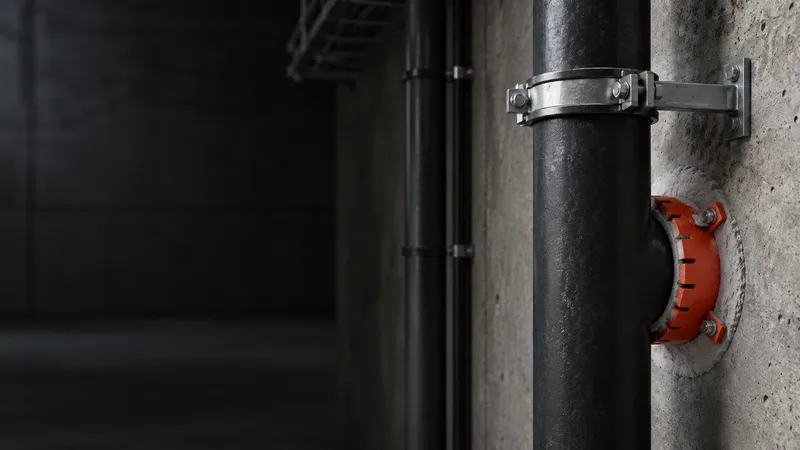
Fire collar, sealant, mortar or PU foam: which system suits which penetration?
It is not the product name but the complete application that determines whether a seal is right. How to compare collars, sealant, mortar, blocks and special penetration foam.
Read more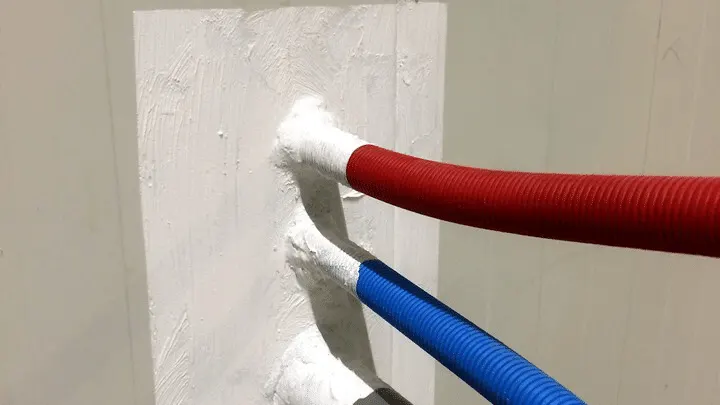
Fire-resistant penetrations: types, requirements (NEN-EN 1366-3), and what it costs
Every cable or pipe through a fire separation is a potential weak point. The sealing systems available, the requirements, and what it costs.
Read moreWhere fire-resistant seals often come into play
Healthcare institutions
Compartmentalization and fire protection provisions in buildings where evacuation is not an option.
View sectorData centers
Fire separations and penetrations around critical IT infrastructure, executed without downtime.
View sectorEducation
Fire protection provisions in school buildings, scheduled around the class timetable and holidays.
View sectorParking garages
Structural protection and compartmentalization in parking garages, including the risks of EV charging.
View sectorRelated services
Fire-Resistant Steel Cladding
Fire-resistant cladding or coating for steel beams and columns, so load-bearing capacity is retained for up to 120 minutes in a fire.
More about fire-resistant steel claddingFire-Resistant Glass
Fire-resistant glass made to measure: glazed partitions, screens and glazing with EI 30 or EI 60 classification, supplied and installed.
More about fire-resistant glassFire-Resistant Doors
Fire doors made to measure, adjusted or refurbished: up to 60 minutes fire resistance, smoke-resistant where required, self-closing and certified.
More about fire-resistant doorsActive in: Den Haag · Rotterdam · Zuid-Holland · Utrecht · Amsterdam and more