
The challenge
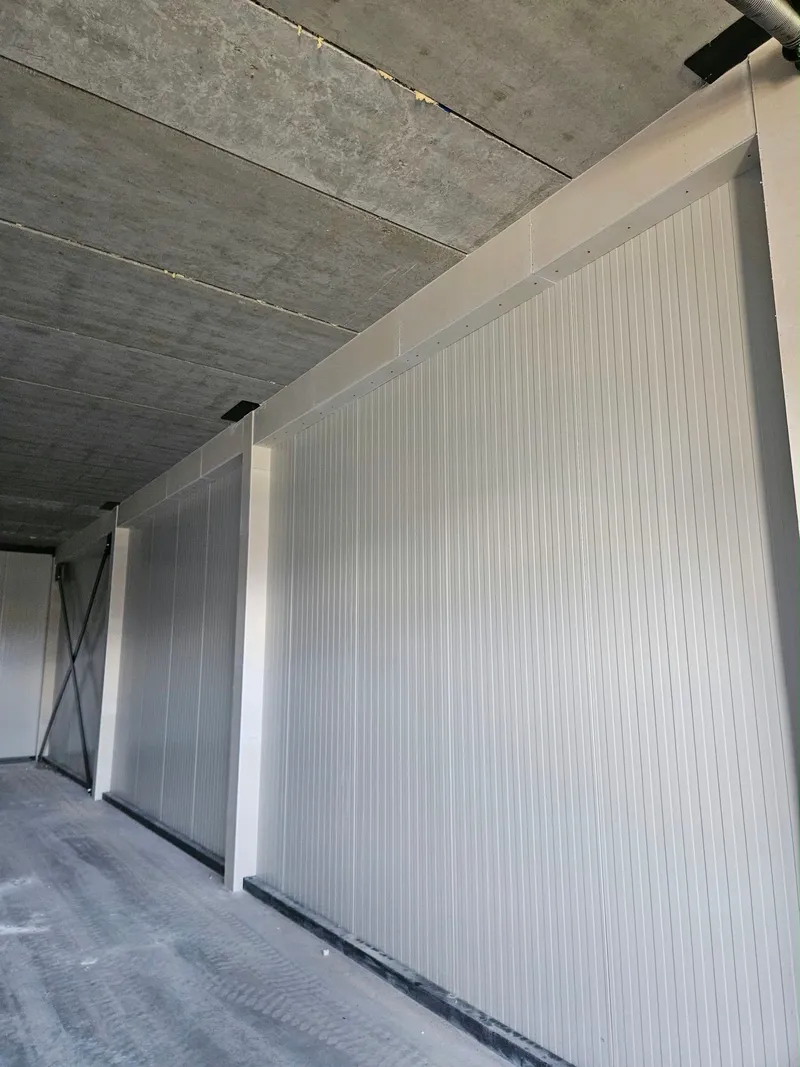
In this commercial unit in Emmeloord, the prefabricated concrete floor above rests on a steel frame: columns along the wall and edge beams directly beneath the floor. Unprotected steel loses a large part of its load-bearing capacity in a fire at around 500 to 600 degrees. To keep the structure standing for the required fire-resistance period, the columns and beams had to be fully encased in fire-resistant cladding - neatly finished and able to withstand the daily use of a commercial unit.
Our approach
Our specialist surveyed the steel sections on site and matched the board thickness for each section to its section factor and the required fire resistance. The fire-resistant boards were cut to size in advance and set out per column, so installation could continue without interruption. Each section was then boxed in: the boards close tightly all round, are fixed mechanically and run from the floor up to the underside of the concrete floor. The edge beams were encased in the same way, so that column and beam together form one continuous, closed cladding.
Key facts
- Project type: Commercial unit with a steel load-bearing structure
- Location: Emmeloord
- Year: 2026
- Certificates: All handed over on completion
- File: Recorded and kept up to date by us
Services deployed
From unprotected steel to closed cladding
The same wall, before and after installation. Tap or click a photo to enlarge it.


What we carried out
- Survey of the steel columns and edge beams on site
- Board thickness per section determined from section factor and required fire resistance
- Fire-resistant boards cut to size in advance and set out per column
- Columns boxed in, continuous from floor to ceiling
- Edge beams beneath the concrete floor fully encased
- Tight junctions with floor, ceiling and wall panels
The result
The columns and edge beams along this wall now have a closed board cladding with crisp corners and continuous joints. The steel load-bearing structure is thereby protected for the required fire-resistance period, with a finish that withstands the daily use of a commercial unit. For each section it is recorded which boards and which thickness were applied, so that during an inspection it can be demonstrated what was installed.
How the cladding was installed
In 19 seconds: this is how a steel column is clad with fire-resistant boards.
- Fitting the boardEach board is placed against the section and checked for size before it is fixed.
- Closing all roundTogether the boards form a closed box around the column; the joints meet tightly.
- FixingThe boards are fixed to each other at regular intervals, from the floor to the top of the column.
- Checking and recordingAfter installation, junctions and joints are checked and the work is recorded per section.
All certificates handed over, everything recorded
At handover, the client received all certificates. Every provision we installed has been recorded, and we keep those records up to date.
For each column and beam, the file records the fire-resistant boards applied and their thickness, with photos of the cladding before and after installation.
A certificate alone does not prove that a provision is right. What also matters is where and how the product was applied. That is why the record for each provision states which system was installed where. This lets the owner show that the fire protection provisions are present and correctly installed.
Is there an inspection by the municipality, fire service or insurer, or is a pipe or cable added later? Then the file shows straight away which system is where, so that a seal that has been opened can be restored with a suitable system.
Fire safety duty of care under the Bbl: what does it mean for owners and users?In the file
- All certificates, handed to the client at handover
- For each provision: the location, the material and the date
- Photos of the work
- Kept up to date by us, also after handover
What this means for your own building
Board cladding or coating?
In a commercial unit with vehicles and goods, board cladding is less vulnerable to impacts than a coating layer, and dry installation has no drying times. Which route fits also depends on the requirement, the section and the situation on site.
Fire-resistant coating or cladding: which suits your steel structure?Board thickness differs per section
The board thickness needed follows from each section's section factor and the required fire-resistance period. A slender section heats up faster and needs thicker cladding than a heavy one.
Fire-Resistant Steel CladdingKeep the cladding intact
A box later damaged by a forklift or a renovation no longer fully protects the steel at that spot. So check the cladding periodically and have any damage repaired.
Logistics & industryOther work by our team
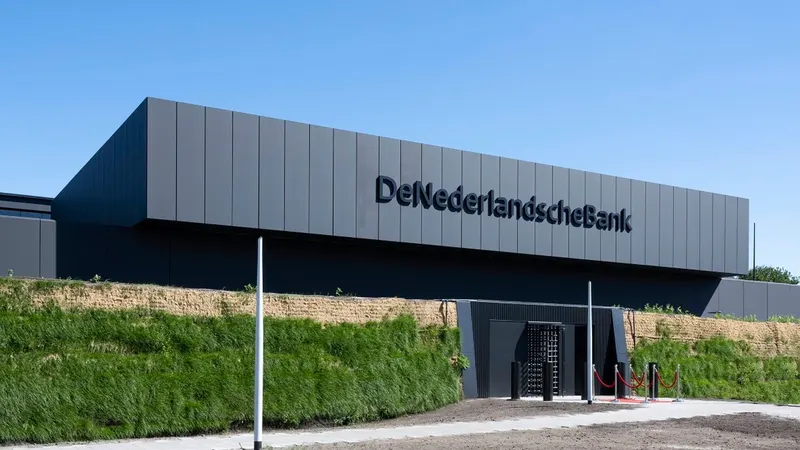
De Nederlandsche Bank
Complete upgrade of the fire compartmentalization during a large-scale office renovation.

Cooltower Rotterdam
Fire-safe compartmentation in a new residential tower of more than 150 metres in the centre of Rotterdam.

WTC Amsterdam
Fire-safe compartmentalization and doors in a continuously leased multi-tenant office complex.